
8 Months in a Boat Yard
The 50 or so workers in the boatyard know me by name and in the
mornings we greet each other in French or Tahitian.
Each day I hitchhike to the supermarket and my rides are often
no longer strangers.
Sometimes if the weather is nice and the shopping not too heavy
I’ll choose to walk the 3 kilometers (about 2 miles) back which is
mostly downhill.
If there is a bus coming from or going to Papeete in my direction
I wave and they stop for me.
Yesterday I was walking back to the boatyard and halfway there
it started to rain so I sheltered by the side of the road under the
wide leaves of a Bird of Paradise plant.
I sat there completely dry and feeling grateful for the freedom I have
at this stage of my life.
It rains heavy most days here in Taravao, the small waistband of the
figure of eight shaped island of Tahiti.
I’m here with my boat up on the land for cyclone season because
it’s the most protected place west of the Marquesas.
At the supermarket I buy a pre-made lunch and dinner cheaper than
buying the ingredients.
It also alleviates the need to cook, a precarious thing right now
because I’m replacing the two burners of my kerosene (paraffin)
stove. With that out of action I’m balancing a camping gas burner
on top of the stove with a pan balanced on top of that.
Fire on a boat is hazardous. The couple on the boat next to mine
have been working for two years to rebuild the interior of theirs after
the lithium batteries caught fire while on passage to the Tuamotos.
With no way to extinguish them (that’s the problem with lithium) the
boat was sailed back to Tahiti with a fire down below.
Luckily the boat is aluminum otherwise it would have sunk.
The young owners are from Quebec and they are my best friends here.
They call me family and each night at “beer O’clock” we sit on the
dock of the marina with drinks and pre-dinner crudites and with
bare feet dangling over the edge we watch the large turtle that lives
between the rocks in the water below.
I have a dog. He’s the boatyard dog really, but he follows me
everywhere.
He joins us on the dock but disappears at some point to take the
sandals we leave at the beginning of the boardwalk.
We find them about 100 yards away still approximately side by side.
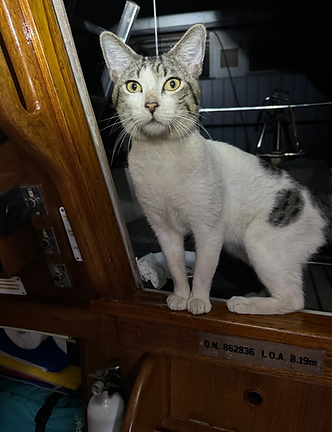
For a while I had a cat I named “Bernard” after Bernard Moitessier,
the legendary French sailor who called this island his home.
Bernard the cat climbed the long ladder up to the boat one night,
I fed him and he never left. I didn’t want him inside but he gradually
worked his way there and all was fine until one day he didn’t want to
go down the ladder in the rain to pee, so he did it on the gear stowed
ironically in the ‘wet’ locker.
After that Bernard slept outside under the deck covers.
When I was about to return to New York for a couple of months I worried
for Bernard, but the yard Manager told me the cat has lived his life
moving from boat to boat and he’d be fine.
As it turned out a local homeowner adopted Bernard and I’m told now
he eats fish every day.
In between working to restore their boat my Quebecois neighbors deliver
yachts, usually across the Atlantic.
We were hoping their boat would be ready soon and we might head
toward Tonga together but a delivery opportunity has come up for them
which will probably keep them in French Polynesia for another season.
This is very much the voyager’s life. Making close friends, saying goodbye,
wondering if we’ll ever see each other again.
On Thursday nights I go to a local bar called “The Factory”.
It’s open on Friday nights too but Thursday is when everyone I know goes.
Like the people who give me a lift to the supermarket everyone at
The Factory tries to talk to me, even if their English is as poor as my French.
Dennis is the owner of the place. He like many of the people here comes
from France, but he has many Tahitian tattoos.
He tells me he loves Taravao because it’s a small community and quiet.
He thinks Papeete is too crowded and busy. I laugh and tell him he should
visit New York.
I came close to dying in this boatyard.
Before I started hitchhiking to the supermarket, I rode a small bicycle there
and back. In the rain, on the one day I decided not to wear a crash helmet,
the bike hit a submerged ditch in the boatyard and I woke up in an
ambulance.
I had been unconscious I was later told for about 20 minutes.
The accident left me with a concussion that lasted 6 months.
During that time, I was unable to read with both eyes open, and
my feet felt like they weren’t touching the ground.
In Melbourne Australia, where I grew up, sometimes in the summer the
asphalt on our street would melt and bubble into heat blisters.
My parents would say it was so hot outside you could fry an egg on
the sidewalk. I did it once to prove them right.
I mention this to say I know heat, but nothing like the heat of a Tahitian
summer. Here by midday the teak wood in the cockpit of my boat is too hot
to stand on in bare feet. Inside the boat you can’t wear clothes because
you are under a shower, except what is running down your body is sweat.
The humidity, intensity of the sun, and frequent downpours, make living
in the boatyard challenging.
You can’t drink the tap water here and when it has rained vigorously it
comes out chocolate brown.
13 kilometers (about 8 miles) away though there is a short stone wall
with taps that supply fresh water from the mountain, and we go there to
fill up plastic bottles with it.
I have also filled the 45-gallon (170 liter) water tanks of my boat from there.
It took many trips and many plastic bottles, but I’m busy re-provisioning
for a voyage again. The cyclone threat is almost past and I have released
the ropes that tied the boat to large concrete blocks on either side.
Soon we’ll be back on the water, and I need to get moving before my visa
expires.
I love it here.
When I drop the mooring line, it will be hard to let go.
Addendum
Things to do in a boatyard:
Wash everything throughout the boat in fresh water, including all pots, pans,
cups, glasses, cutlery, bed linen, wet weather gear, sleeping bags, clothing
and equipment.
Wash, dry, inspect, and have repaired where necessary all the sails then
carefully store away from the humidity as best you can.
Remove all the running rigging and replace with thin tracer lines. Then wash,
dry and stow all the ropes down below.
Take out all the anchor chain, (200 ft -61 meters) wash and air before
returning to the locker.
Drain the water tanks, flush the bilge, and lay up the engine as if for winter.
(They have never heard of anti- freeze liquid here.)
Wash, dry, and bag the dinghy then store in a locker.
Wipe the entire inside of the boat with white vinegar to protect against mold.
Wash and stow the life raft on a berth below decks.
Strip, clean, and grease all the winches (There are 9 of them)
Re-grease all the seacocks.
Re- grease the boat’s folding propeller.
Strip the flaking antifouling off the bottom of the boat.
A simple sentence here that took every day for a month using a scraper,
chisels, angle grinder, orbital sander, and hand sanding, all while wearing
a hazmat suit, particle mask, safety glasses, and rubber boots because
antifouling paint is toxic. Geared up like this in the Tahitian heat work could
only be done from sunrise to about 10.30 am and then 4.30 pm until sunset.
When finally, almost back to the original barrier coat, repaint the bottom
with 2 coats of self-etching primer, then 2 coats of antifouling, plus an extra
coat around the waterline, because that gets the most wear.
Time all this painting for the rare days with no rain.
Cut and polish the entire outside of the boat (above the waterline)
Done twice. Once mid-term to protect from the sun and once
before re-launching.
Replace the chafed endless line of the foresail roller furler.
Replace the two lower forward shroud (rigging) wires.
Make a new battery cover to fit the battery installed in the Galapagos.
Strip, repair, and paint the companionway washboards.
Remove the stainless-steel cover over the rudder head and inspect
for any damage beneath.
Strip the propeller of the special antifouling paint, prepare and re-paint
with the same.
Remove, wash, refit the two canvas lee cloths.
(These hold you in your berth at sea.)
Replace the two stove burners.
Renew all the water pipes from the water tanks to the galley and
washbasin pumps.
Fit a new galley pump and water filter.
Remove all stores and parts from every locker and create an updated
list of what is where and what food needs to be re-provisioned.
Replace the engine anode and all anodes on the bottom of the boat.
(Propeller, rudder, rope cutter, etc;) Anodes are a soft metal designed to
erode and protect from electrolysis – an electrical current created by salt
water and dissimilar metals such as stainless-steel and bronze.
Renew the engine water pump impeller.
Remove the flexible water tanks and treat them with diluted bleach.
Wait 4 hours then flush, refit the tanks, and refill.
Look forward to “beer O’clock.”


Removing the antifouling
Bernard the cat appears
Christmas with my friends on their boat next door
